
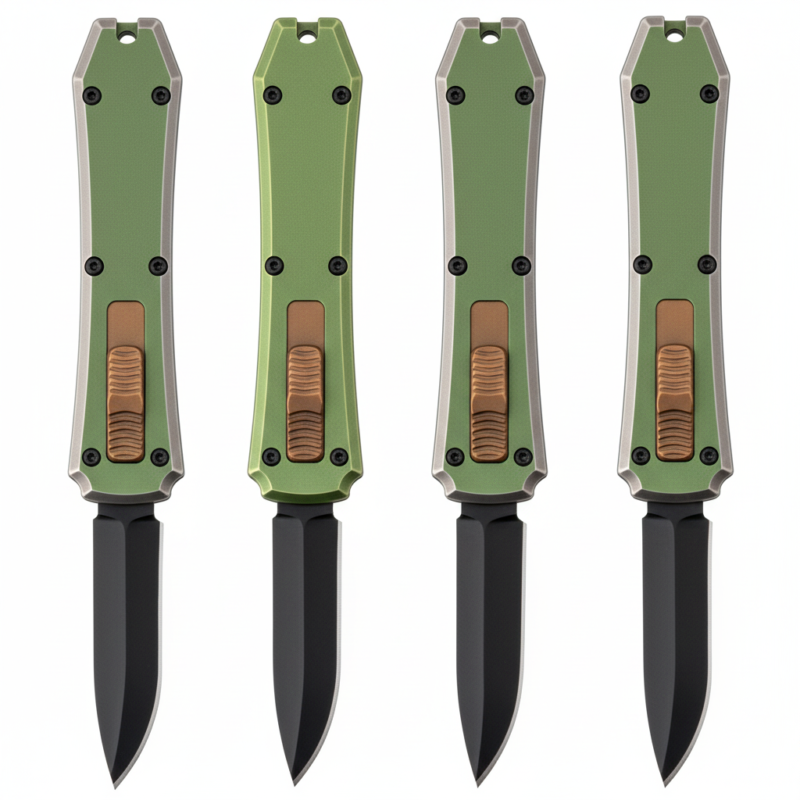
Short answer
A neutral, specific guide to aluminum vs zinc alloy OTF knife handles, covering weight, tolerances, thread durability, finish, impact wear, and when zinc alloy
Key Takeaways
- Knife rules can vary by state, city, blade style, opening mechanism, carry method, and intended use.
- Do not treat a product nickname as a legal category; check the actual features and local rule.
- Retailers should keep legal or safety language factual and avoid promising that one item is allowed everywhere.
Terms Used Here
- OTF
- Out-the-front; a knife design where the blade moves forward from the front of the handle.
- Automatic knife
- A knife that opens by a spring-driven mechanism after the user activates a button, switch, or slider.
In this article
- 01 Quick comparison: aluminum vs zinc alloy for OTF handles
- 02 Decision criteria before ranking the materials
- 03 1) Weight and carry comfort
- 04 2) Machining and tolerance implications for OTF handles
- 05 3) Thread durability and repeated disassembly
- 06 4) Finish differences: anodized aluminum vs coated zinc alloy
- 07 5) Impact resistance and wear tradeoffs
- 08 6) When zinc alloy is the smarter choice
- 09 What would change my recommendation
- 10 FAQ
- 11 Does aluminum make an OTF knife more reliable?
- 12 Is 7075 aluminum better than 6061 for OTF handles?
- 13 Are all zinc-alloy OTF handles made from the same material?
- 14 Which handle material is better for everyday carry?
- 15 When should I still consider a zinc-alloy OTF?
- 16 Does this advice also apply to utility or defensive carry categories?
Usually yes: an aluminum handle is the better choice for most OTF knife users because it is lighter and is more often paired with tighter machining. Zinc alloy mainly makes sense on lower-cost OTF knives where extra weight, simpler finishes, and lower thread durability are acceptable tradeoffs.
This article answers the user-level question first, not the wholesale question. What is known: common aluminum handle alloys such as 6061 and 7075 are much less dense than common zinc die-casting alloys such as Zamak 3 or Zamak 5, and many production OTFs use CNC-machined aluminum while budget models often use cast zinc alloy. What depends: alloy grade, wall thickness, casting quality, thread design, inserts, coatings, and factory tolerances. What is not being claimed: that every aluminum OTF is better than every zinc-alloy OTF, or that handle material alone determines firing reliability.
Quick comparison: aluminum vs zinc alloy for OTF handles
| Factor | Aluminum handle | Zinc alloy handle |
|---|---|---|
| Typical material examples | 6061-T6, 7075 | Zamak 3, Zamak 5 |
| Density and carry weight | Much lighter; aluminum is about 2.7 g/cm³ | Much heavier; zinc alloys are about 6.6 to 6.8 g/cm³ |
| Common manufacturing method | CNC-machined billet or extruded stock | Pressure die cast, then machined in key areas |
| OTF tolerance potential | Often better, especially on well-machined bodies | Can be acceptable, but more dependent on casting and post-machining quality |
| Thread durability | Usually better, especially with good thread engagement or steel inserts | More prone to thread wear or stripping if over-torqued |
| Finish options | Anodizing works well; color is integrated into surface oxide layer | Usually paint, plating, or coating over base metal |
| Wear pattern | Can dent or scratch; anodizing can show edge wear | Can chip or wear through coatings; corners may show finish loss quickly |
| Cost | Usually higher | Usually lower |
| Best use case | Everyday carry, lighter pocket carry, mid-range and better builds | Budget OTFs, novelty models, low opening-price products |
Decision criteria before ranking the materials
For an OTF knife, the handle is not just a shell. It houses the rails, supports the screws, guides the slider, and affects how the knife feels every time you fire it. The most useful criteria are:
- Carry weight: does the knife disappear in the pocket or feel dense for its size?
- Tolerance control: does the handle support smooth slider travel and consistent internal alignment?
- Thread durability: can the screws survive clip swaps, cleaning, or occasional disassembly?
- Finish behavior: will the surface wear gracefully or start looking rough after pocket carry?
- Impact and edge wear: does the handle dent, chip, or lose coating at corners?
- Price target: is this a budget knife or something meant to feel refined?
On those criteria, aluminum is usually the better all-around answer for users. Zinc alloy is the value option, not automatically a bad option.
1) Weight and carry comfort
The clearest technical difference is density. Aluminum is roughly 2.7 g/cm³, while common zinc alloys are around 6.6 to 6.8 g/cm³. That means a zinc-alloy handle can weigh well over twice as much as an aluminum handle of similar size if the design and wall thickness are similar.
In real OTF use, that usually means:
- an aluminum OTF feels easier to carry all day
- a zinc-alloy OTF often feels heavier and more pocket-present
- some users interpret that extra heft as solidity, but heft is not the same thing as mechanical strength
If you carry an OTF clipped in athletic shorts, light pants, or as a backup utility knife, aluminum is usually the more comfortable choice. If the knife mostly lives in a bag, glove box, or display case, the weight penalty of zinc alloy matters less.
2) Machining and tolerance implications for OTF handles
This is where many articles become too absolute. Aluminum is not automatically more precise than zinc alloy; manufacturing quality decides that. But in many production OTFs, aluminum handles are CNC-machined from billet or bar stock, and that process tends to support tighter, more repeatable dimensions in the areas that matter: rail tracks, screw bores, and slider channels.
Zinc alloy handles are commonly die cast. Die casting is efficient and cost-effective, but cast parts often rely more heavily on mold quality, shrink control, and post-machining in critical areas. A well-made cast zinc handle can work fine. A poorly controlled one may show inconsistent fit, rougher internal surfaces, or more variation from one batch to another.
For OTF knives, that difference matters because the mechanism depends on alignment. If the internal track geometry is off, the user may feel drag, grittiness, or inconsistent actuation. So the practical rule is: all else equal, a well-machined aluminum OTF handle gives the manufacturer a better starting point for precise fit.
Concrete caveat: if the maker machines only the outside of the aluminum body but leaves poor internal finishing, the material advantage does not save the knife. Internal design and process control still matter more than the label on the spec sheet.
3) Thread durability and repeated disassembly
This is one of the most useful differences for owners who remove clips, open the handle for cleaning, or service springs. Aluminum threads are not indestructible, but they are usually more forgiving than threads cut directly into zinc alloy on low-cost knives.
Why? In many budget OTFs, zinc-alloy handles are paired with small screws and shallow thread engagement. If those screws are over-torqued, cross-threaded, or removed repeatedly, the threads can wear faster. Aluminum can also strip, especially in softer 6061 if abused, but it usually holds up better in this application when the design is sound. Better still is any handle, aluminum or otherwise, that uses steel threaded inserts in high-stress points.
So if you expect to open the knife more than occasionally, aluminum is usually the safer choice. If you never plan to disassemble the knife and only want a low-cost OTF, zinc alloy may be good enough.
4) Finish differences: anodized aluminum vs coated zinc alloy
Appearance claims and material-performance claims are not the same thing. A zinc-alloy handle can look excellent in photos, and a cheap aluminum handle can look bad. But the finish systems are different.
Aluminum is commonly anodized. Anodizing creates a controlled oxide layer on the surface, which can improve corrosion resistance and allow stable colors. It is not magic armor, and edges can still wear shiny, but anodized aluminum often ages in a more predictable way.
Zinc alloy is usually painted, powder coated, plated, or otherwise top-coated. Those finishes can look good at first, but on lower-cost knives they may wear through at corners, around screws, or where the clip rubs. Once the coating chips or thins, cosmetic wear can become more obvious.
If finish longevity matters to you, aluminum has the edge in many OTFs. If your priority is simply the lowest purchase price, zinc finishes can be acceptable as long as expectations stay realistic.
5) Impact resistance and wear tradeoffs
Aluminum is not perfect. It is lighter, but it can dent, scratch, or show edge wear when dropped. A 6061 handle may mark up more easily than some users expect. Harder alloys such as 7075 can improve strength, but they also cost more and are not universal in production OTFs.
Zinc alloy has its own tradeoffs. It can feel solid because of its weight, but cast zinc corners and coated surfaces may chip or show ugly finish damage after impact. In other words, zinc can feel stout in hand while still being less satisfying over time if the coating fails or threads degrade.
For a true user knife, aluminum usually wears better overall. For a low-cost knife that may not see years of pocket carry, zinc alloy can be acceptable.
6) When zinc alloy is the smarter choice
Zinc alloy is the smarter choice when one or more of these are true:
- Price matters most: you want the lowest-cost OTF that still functions reasonably well.
- Weight is not a problem: the knife is for casual use, a drawer, a vehicle, or occasional novelty carry.
- You do not plan to service it: limited disassembly means thread wear matters less.
- The maker has good casting quality: some zinc-alloy knives are perfectly usable when the design and post-machining are competent.
That is why zinc alloy still exists in the market. It helps manufacturers hit lower price points. It is not the better engineering choice for most users, but it can be the better budget choice.
What would change my recommendation
I would be more favorable to zinc alloy if the handle used a high-quality die casting, critical internal areas were machined cleanly, screw points had generous thread engagement or steel inserts, and the price savings were substantial. I would be less favorable to aluminum if the knife had poor anodizing, sloppy internal machining, or a soft design that dented easily in normal use.
So the recommendation is conditional, not ideological: for most users, aluminum is better; for some budget knives, well-executed zinc alloy is still reasonable.
FAQ
Does aluminum make an OTF knife more reliable?
Not by itself. Reliability depends on spring design, blade fit, rails, button geometry, and assembly quality. Aluminum simply tends to be used in builds where tighter machining is more achievable.
Is 7075 aluminum better than 6061 for OTF handles?
Usually yes in raw strength terms, but many OTF users will notice weight, machining, and finish quality before they notice the difference between 6061 and 7075. A well-made 6061 handle is still preferable to a poorly made zinc-alloy one in most cases.
Are all zinc-alloy OTF handles made from the same material?
No. Many are based on Zamak-family alloys such as Zamak 3 or Zamak 5, and quality varies with casting control, wall thickness, and post-machining. “Zinc alloy” is too broad to judge on name alone.
Which handle material is better for everyday carry?
Aluminum, in most cases, because lower density makes the knife easier to carry and usually gives a more refined feel.
When should I still consider a zinc-alloy OTF?
Consider it when budget is the main factor and you accept more weight and a shorter cosmetic or service life. If you are browsing entry-level models, compare examples in an OTF knife collection and treat zinc alloy as a cost-saving feature, not a premium one.
Does this advice also apply to utility or defensive carry categories?
Generally yes. If the knife may be carried often or handled hard, lower weight and better thread durability usually matter more, which is one reason aluminum is common across many self-defense products and carry-oriented tools.